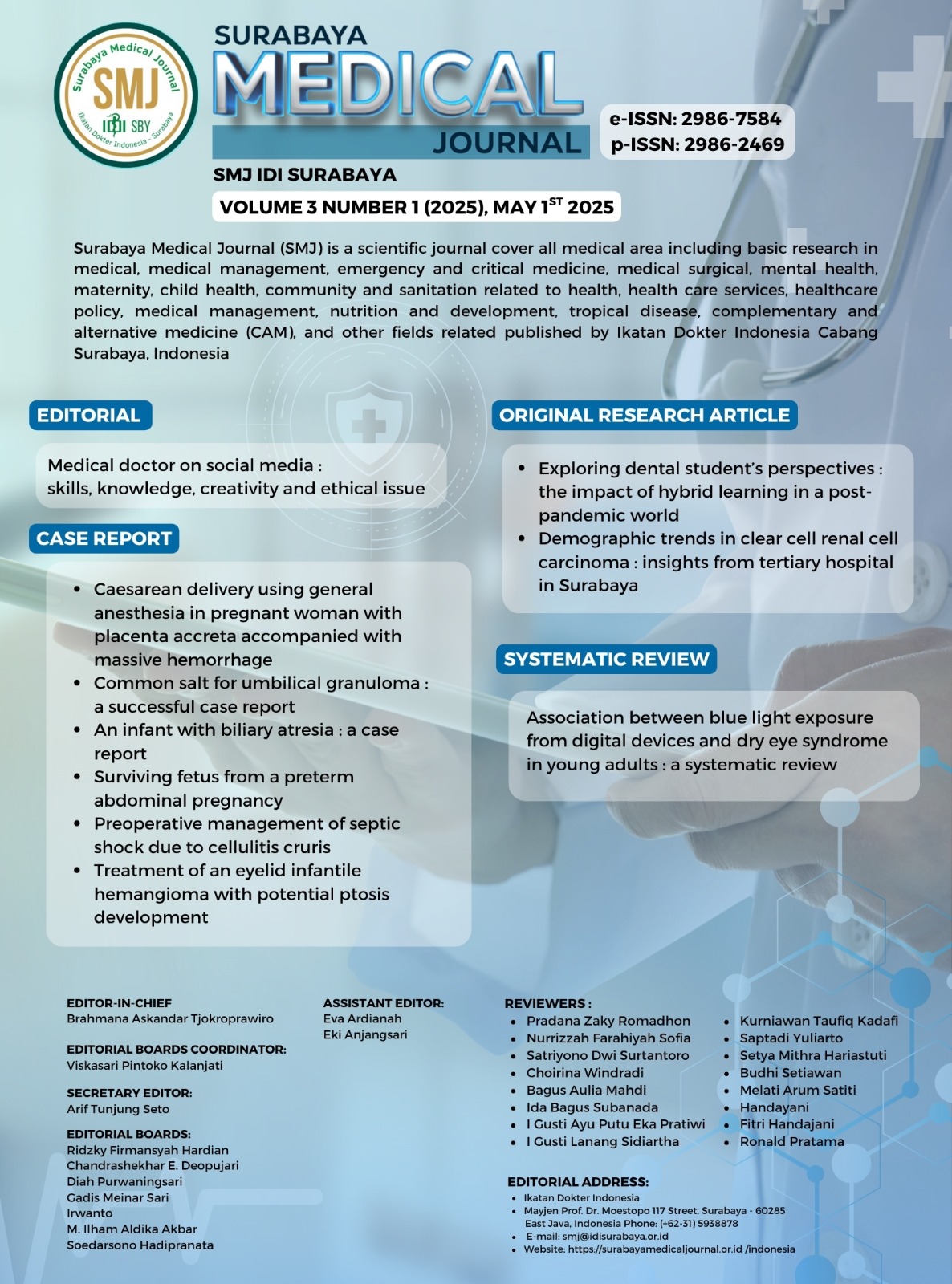
An Infant with biliary atresia: a case report
An infant with biliary atresia
DOI:
https://doi.org/10.59747/smjidisurabaya.v3i1.99Abstract
Background: In children, biliary atresia (BA) is the most frequent cause of liver transplantation. Cholestasis, an early sign of biliary atresia, is rarely identified by primary care physicians as it is often mistaken for physiological jaundice. Early detection of biliary atresia is necessary to optimize outcomes and prevent end-stage liver disease. Case Presentation: A 2-month-old baby girl presented to the hospital with complaints of persistent jaundice since birth, accompanied by pale-colored stools. Physical examination revealed sclera icteric, hepatomegaly, splenomegaly, and umbilical hernia were found. Laboratory results showed a direct bilirubin level of 5.98 mg/dL, total bilirubin 7.22 mg/dL, albumin 3.31 g/dL, ALP 223 U/L, GGT 360.4 U/L, AST 307 U/L, ALT 313 U/L, APTT 34.2 seconds, and PT 12.4 seconds, Toxoplasma IgG 3.3 (reactive), CMV IgG 90.4 (reactive), and CMV IgM 3.09 (reactive). Thyroid function tests showed FT4 level of 360.4 ng/dL and TSH 307 µIU/mL suggesting congenital hypothyroidism. A 2-phase abdominal ultrasound examination showed impaired gallbladder contractility. Liver biopsy showed extrahepatic cholestasis and fibrosis of the portal tract (F1 stage). Contrast-enhanced MRCP was performed and showed biliary atresia with hepatosplenomegaly. The patient was diagnosed with biliary atresia, CMV infection, and congenital hypothyroidism. The patient was referred to pediatric surgery for Kasai portoenterostomy (KPE) surgery. Conclusion: The diagnosis of biliary atresia requires a combination of several laboratory modalities as well as radiologic and histopathologic studies. Early detection of cholestasis is necessary; if the infant is found to be jaundice at 2 weeks of age, serum bilirubin levels must be evaluated to avoid delays in BA management
References
Alrehaili, J., 2023. Leprosy Classification, Clinical Features, Epidemiology, and Host Immunological Responses: Failure of Eradication in 2023. Cureus 15, 1–19.
Bakker, M.I., Hatta, M., Kwenang, A., Van Mosseveld, P., Faber, W.R., Klatser, P.R., Oskam, L., 2006. Risk factors for developing leprosy - A population-based cohort study in Indonesia. Lepr. Rev. 77, 48–61.
Bhat, R.M., Prakash, C., 2012. Leprosy: An overview of pathophysiology. Interdiscip. Perspect. Infect. Dis. 2012.
Celestino, I.C., Antunes, D.E., Santos, D.F., Gimenes, V.L., de Souza, F.M., Goulart, I.M.B., 2024. Adverse reactions induced by MDT/WHO (Rifampicin+Clofazimine+Dapsone) and ROM (Rifampicin+Ofloxacin+Minocycline) regimens used in the treatment of leprosy: a cohort study in a National Reference Center in Brazil. Front. Pharmacol. 15, 1–9.
Cellona, R. V., Balagon, M.V.F., Dela Cruz, E.C., Burgos, J.A., Abalos, R.M., Walsh, G.P., Topolski, R., Gelber, R.H., Walsh, D.S., 2003. Long-term Efficacy of 2 Year WHO Multiple Drug Therapy (MDT) in Multibacillary (MB) Leprosy Patients. Int. J. Lepr. Other Mycobact. Dis. 71, 308–319.
Chen, K.H., Lin, C.Y., Su, S. Bin, Chen, K.T., 2022. Leprosy: A Review of Epidemiology, Clinical Diagnosis, and Management. J. Trop. Med. 2022.
Chen, X., Liu, H.B., Shui, T.J., Zha, S., 2021. Risk factors for physical disability in patients with leprosy disease in yunnan, china: Evidence from a retrospective observational study. PLoS Negl. Trop. Dis. 15, 1–14.
Deps, P.D., Nasser, S., Guerra, P., Simon, M., Birshner, R.D.C., Rodrigues, L.C., 2007. Adverse effects from Multi-drug therapy in leprosy: A Brazilian study. Lepr. Rev. 78, 216–222.
Ebenezer, G.J., Scollard, D.M., 2021. Treatment and Evaluation Advances in Leprosy Neuropathy. Neurotherapeutics 18, 2337–2350.
Edi, G.F.A., Azizah, R., 2023. Analysis of Environmental Risk Factors for Leprosy in Indonesian Society: Meta-Analysis. Poltekita J. Ilmu Kesehat. 17, 105–113.
Fonseca, A.B. de L., Simon, M. do V., Cazzaniga, R.A., de Moura, T.R., de Almeida, R.P., Duthie, M.S., Reed, S.G., de Jesus, A.R., 2017. The influence of innate and adaptative immune responses on the differential clinical outcomes of leprosy. Infect. Dis. Poverty 6, 1–8.
Franco-Paredes, C., Garcia-Creighton, E., Henao-Martínez, A., Kallgren, D.L., Banjade, R., Dyer, J.A., Nelson, T., Zaesim, A., Peluso, M.J., Jain, V., Lee, D.H., Minces, L.R., Wirshup, M., Hoffman, M.S., Katsolis, J., Brust, K., Giron, J., Smiarowski, L., Hoosepian-Mer, P.A., Stryjewska, B., Abstract:, 2022. Novel approaches in the treatment of Hansen’s disease (Leprosy): a case series of multidrug therapy of monthly rifampin, moxifloxacin, and minocycline (RMM) in the United States. Ther. Adv. Vaccines 9, 1–10.
Froes, L.A.R., Sotto, M.N., Trindade, M.A.B., 2022. Leprosy: clinical and immunopathological characteristics. An. Bras. Dermatol. 97, 338–347.
Gofur, N.R.P., Gofur, A.R.P., Putri, H.M., Soesilaningtyas, Halimah, A.N., Feriana, D., Rusdiana, E., Wahjuni, S., Rosa, M.L.L., Yusof, Z.Y.B.M., 2023. Drug choice to lowering risk contiguity with Morbus Hansen disease: A review article. J. Adv. Pharm. Educ. Res. 13, 73–79.
Goncalves, H. de S., Pontes, M.A. de A., Bührer-Sékula, S., Cruz, R., Almeida, P.C., de Moraes, M.E.A., Penna, G.O., 2012. Brazilian clinical trial of uniform multidrug therapy for leprosy patients - The correlation between clinical disease types and adverse effects. Mem. Inst. Oswaldo Cruz 107, 74–78.
Guragain, S., Upadhayay, N., Bhattarai, B.M., 2017. Adverse reactions in leprosy patients who underwent dapsone multidrug therapy: A retrospective study. Clin. Pharmacol. Adv. Appl. 9, 73–78.
Hambridge, T., Chandran, S.L.N., Geluk, A., Saunderson, P., Richardus, J.H., 2021. Mycobacterium leprae transmission characteristics during the declining stages of leprosy incidence: A systematic review. PLoS Negl. Trop. Dis. 15, 1–32.
Hansen, G.A., 1875. The etiology of leprosy. Br Foreign Med Chir Rev 55, 459–489.
Kerr-Pontes, L.R.S., Barreto, M.L., Evangelista, C.M.N., Rodrigues, L.C., Heukelbach, J., Feldmeier, H., 2006. Socioeconomic, environmental, and behavioural risk factors for leprosy in North-east Brazil: Results of a case-control study. Int. J. Epidemiol. 35, 994–1000.
Khadilkar, S. V., Patil, S.B., Shetty, V.P., 2021. Neuropathies of leprosy. J. Neurol. Sci. 420, 117288.
Kinanti, H., Kurniati, Faidati, W., 2024. The Burden of Leprosy Reaction in the Post-Elimination Era: A Study from Gresik City, Indonesia. Berk. Ilmu Kesehat. Kulit dan Kelamin 36, 41–46.
Lazo-Porras, M., Prutsky, G.J., Barrionuevo, P., Tapia, J.C., Ugarte-Gil, C., Ponce, O.J., Acuña-Villaorduña, A., Domecq, J.P., De La Cruz-Luque, C., Prokop, L.J., Málaga, G., 2020. World Health Organization (WHO) antibiotic regimen against other regimens for the treatment of leprosy: A systematic review and meta-analysis. BMC Infect. Dis. 20, 1–14.
Li, Y.Y., Shakya, S., Long, H., Shen, L.F., Kuang, Y.Q., 2021. Factors Influencing Leprosy Incidence: A Comprehensive Analysis of Observations in Wenshan of China, Nepal, and Other Global Epidemic Areas. Front. Public Heal. 9, 1–11.
Lockwood, D.N.J., Penna, G.O., Lambert, S., Pai, V.V., Walker, S.L., 2022. Safer and newer antimicrobial drugs for leprosy – time to test monthly ROM in an adequately powered randomised trial? Lepr. Rev. 93, 96–101.
Lubis, R.D., Darmi, M., Prakoeswa, C.R.S., Agusni, R.I., Kusumaputra, B.H., Alinda, M.D., Listiawan, M.Y., Anum, Q., Argentina, F., Menaldi, S.L., Gunawan, H., Yuniati, R., Mulianto, N.R., Siswati, A.S., Widasmara, D., Rusyati, L.M.M., Mamuaja, E.H., Muchtar, V., 2022. Leprosy Epidemiology According to Leprosy Type in 13 Teaching Hospitals in Indonesia between 2018 and 2020. Open Access Maced. J. Med. Sci. 10, 1812–1817.
Martahi, R.L., Tasman, H., 2021. Model of transmission of three types Leprosy Disease with treatment. J. Phys. Conf. Ser. 1725.
Martoreli Júnior, J.F., Ramos, A.C.V., Alves, J.D., Crispim, J. de A., Alves, L.S., Berra, T.Z., Barbosa, T.P., da Costa, F.B.P., Alves, Y.M., Dos Santos, M.S., Gomes, D., Yamamura, M., Pinto, I.C., Fuentealba-Torres, M.A., Nunes, C., Pieri, F.M., Arcoverde, M.A.M., Dos Santos, F.L., Arcêncio, R.A., 2021. Inequality of gender, age and disabilities due to leprosy and trends in a hyperendemic metropolis: Evidence from an eleven-year time series study in central-west Brazil. PLoS Negl. Trop. Dis. 15, 1–16.
Menaldi, S.L., Harini, M., Nelfidayani, N., Irawati, Y., Setiono, S., Wahyuni, L.K., Rahayu, T., Andayani, G., Friska, D., Nugraha, B., 2022. Functional activity limitation of leprosy cases in an endemic area in Indonesia and recommendations for integrated participation program in society. PLoS Negl. Trop. Dis. 16, 1–13.
Menaldi, S.L.S.W., 2020. Pedoman Nasional Pelayanan Kedokteran Tatalaksana Kusta. Kementeri. Kesehat. RI 106.
Nascimento, O.J.M., 2013. Leprosy neuropathy: Clinical presentations. Arq. Neuropsiquiatr. 71, 661–666.
Noer, R.R., Kurniawan, S.N., 2023. Leprosy neuropathy: Clinical presentations. J. pain headache vertigo 4, 27–30.
Oliveira, I.V.P. de M., Deps, P.D., Antunes, J.M.A. de P., 2019. Armadillos and leprosy: From infection to biological model. Rev. Inst. Med. Trop. Sao Paulo 61, 1–7.
Ploemacher, T., Faber, W.R., Menke, H., Rutten, V., Pieters, T., 2020. Reservoirs and transmission routes of leprosy; A systematic review. PLoS Negl. Trop. Dis. 14, 1–27.
Prakoeswa, C.R.S., Lubis, R.S., Anum, Q., Argentina, F., Menaldi, S.L., Gunawan, H., Yuniati, R., Mulianto, N.R., Siswati, A.S., Widasmara, D., Rusyati, L.M.M., Mamuaja, E.H., Muchtar, V., Agusni, R.I., Kusumaputra, B.H., Alinda, M.D., Listiawan, M.Y., 2022. Epidemiology of Leprosy in Indonesia: a Retrospective Study. Berk. Ilmu Kesehat. Kulit dan Kelamin 34, 29–35.
Rahmawati, D., Bimanto, H., 2021. Analysis of Factors Affecting Leprosy Cases in East Java Province with Spatial Autoregressive Model (SAR). J. Berk. Kesehat. 7, 59.
Rahmi, A.M., Listiawan, M.Y., Murtiastutik, D., Nurul, A., Ervianti, E., Utomo, B., 2024. Unveiling the Past : Retrospective Exploration of Multidrug Therapy ( MDT ) Efficacy in Multibacillary Leprosy Patients. Mitig. Lett. 21, 51–58.
Rees, R.J.W., McDougall, A.C., 1977. Airborne infection with Mycobacterium leprae in mice. J. Med. Microbiol. 10, 63–68.
Rosdiana, B., Astari, L., Astindari, A., Prakoeswa, C.R.S., Zulkarnain, I., Damayanti, D., Utomo, B., Listiawan, M.Y., 2021. Risk factors of type 1 leprosy reaction in leprosy patients attending leprosy division of dermatology and venereology outpatient clinic of dr soetomo general hospital in 2017–2019: A retrospective study. Open Access Maced. J. Med. Sci. 9, 1359–1363.
Sales, A.M., Ponce de Leon, A., Düppre, N.C., Hacker, M.A., Nery, J.A.C., Sarno, E.N., Penna, M.L.F., 2011. Leprosy among patient contacts: A multilevel study of risk factors. PLoS Negl. Trop. Dis. 5, 1–6.
Swift, T.R., Sabin, T.D., 1998. Neurological manifestations of leprosy. Neurologist 4, 21–30.
Urban, C., Blom, A.A., Pfrengle, S., Walker-Meikle, K., Stone, A.C., Inskip, S.A., Schuenemann, V.J., 2021. One Health Approaches to Trace Mycobacterium leprae’s Zoonotic Potential Through Time. Front. Microbiol. 12, 1–7.
White, C., Franco-Paredes, C., 2015. Leprosy in the 21st century. Clin. Microbiol. Rev. 28, 80–94.
World Health Organization (WHO), 1969. Classification of disabilities resulting from leprosy, for use in control projects. Bull. World Health Organ. 40, 609–612.
Wulan Dewanti Martamevia, 2024. Epidemiological overview of new cases of leprosy in West Java In 2021-2023, Indonesia. World J. Adv. Res. Rev. 22, 1701–1707.
Downloads
Published
Issue
Section
Categories
License
Copyright (c) 2025 Syania Mega Octariyandra, Bagus Setyoboedi, Anggraini Dian Prameswari, Sjamsul Arief

This work is licensed under a Creative Commons Attribution 4.0 International License.